
Learn About The Law
Get help with your legal needs
FindLaw’s Learn About the Law features thousands of informational articles to help you understand your options. And if you’re ready to hire an attorney, find one in your area who can help.
Current as of January 02, 2024 | Updated by Findlaw Staff
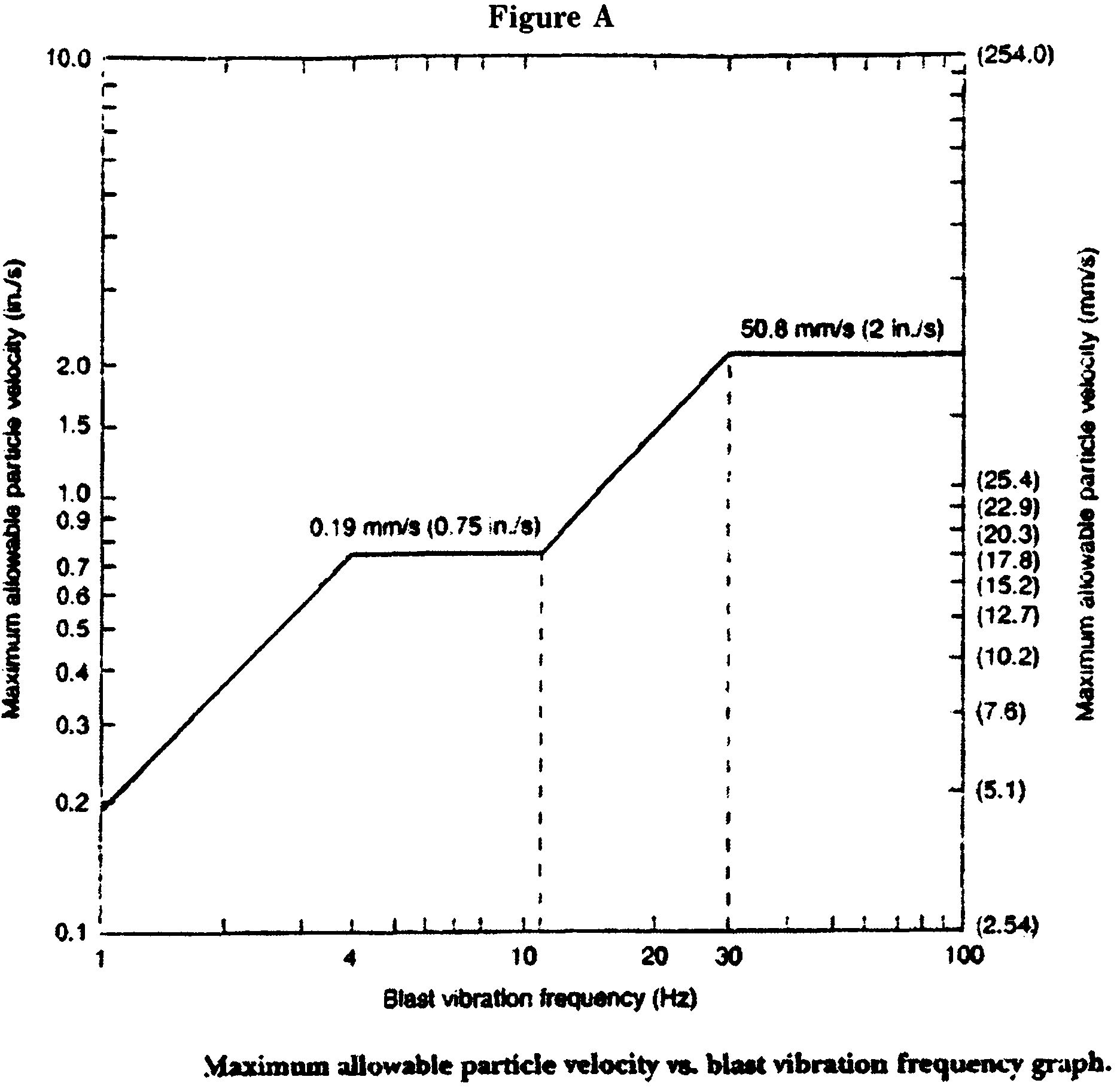
(a) In all blasting operations, except as otherwise provided in this chapter, the maximum ground vibration at a dwelling, public building, school, church, or commercial or institutional building normally occupied adjacent to the blasting site must not exceed the limitations specified in the following graph shown in Figure A to limit peak particle velocity based upon the frequency of the blast vibration:
Figure A
(b) Unless a blaster uses a seismograph to monitor a blast to ensure compliance with Figure A, the operation shall comply with the scaled distance equations shown in the following Table 1.
|
TABLE 1 |
|
|
SCALED DISTANCE EQUATIONS |
|
|
Distance from Blasting Site |
Scaled Distance Equation |
|
|
|
|
0 to 300 ft (91.4 m) |
Standard Table of Distance (see below, Table 2) |
|
|
|
|
301 to 5000 ft (92 m to 1524 m) |
W (lbs) = (d (ft)/55)2 or W (kg) = (d (m)/24.9)2 |
|
|
|
|
5001 ft (1524 m) and beyond |
W (lbs) = (d (ft)/65)2 or W (kg) = (d (m)/29.4)2 |
Key:
W = The maximum weight of explosives in pounds (or kilograms) that can be detonated per delay interval of 8 milliseconds or greater. d = The distance in feet (or meters) from the blast site to the nearest dwelling, public building, school, church, commercial, or institutional building normally occupied not owned, leased, or contracted by the blasting operation, or on property where the owner has not given a written waiver to the blasting operation.
Note: To convert English Units of scaled distances (ft/lb 1/2 ) to metric units (m/kg 1/2 ) divide by a factor of 2.21.
|
|
Table 2: STANDARD TABLE OF DISTANCE (0 to 300 feet (91.4 m)) |
|||
|
|
||||
|
|
Distance in Feet |
Weight in Pounds |
||
|
|
||||
|
|
|
0-10 |
|
1/8 |
|
11-15 |
1/4 |
|||
|
16-20 |
1/2 |
|||
|
21-25 |
3/4 |
|||
|
26-30 |
1.00 |
|||
|
40 |
2.25 |
|||
|
50 |
3.50 |
|||
|
60 |
4.75 |
|||
|
70 |
6.00 |
|||
|
80 |
7.25 |
|||
|
90 |
8.50 |
|||
|
100 |
9.75 |
|||
|
110 |
11.00 |
|||
|
130 |
13.50 |
|||
|
150 |
16.00 |
|||
|
170 |
18.50 |
|||
|
190 |
21.00 |
|||
|
210 |
23.50 |
|||
|
230 |
26.00 |
|||
|
250 |
28.50 |
|||
|
270 |
31.00 |
|||
|
290 |
33.50 |
|||
|
300 |
34.75 |
(c) Airblast resulting from blasting activities must not exceed one hundred forty decibels (140 dB) at the location of a dwelling, public building, school, church, or commercial or institutional building that is not owned or leased by the person engaged in the blasting operation, or on property for which the owner has not provided a written waiver to the person engaged in the blasting operation.
(d) In estimating the peak particle velocity at a particular position, the following equation must be used:
In the equation, V0 is the maximum ground particle velocity at the seismograph, D0 is the distance of the seismograph from the blasting, and D is the distance from the blast to the position in question and in the same general direction. The distance D0 may not be greater than D, and D cannot be more than five (5) times D0.
(e) Blasting operations at permanent sites are considered as being within the limits set forth in this section if at specified locations, on at least five (5) blasts, instrumentation has shown the peak particle velocity and frequency to be within the limits of Figure A. Periodic seismic monitoring must be employed to ensure compliance with applicable law.
Cite this article: FindLaw.com - Tennessee Code Title 68. Health, Safety and Environmental Protection § 68-105-104 - last updated January 02, 2024 | https://codes.findlaw.com/tn/title-68-health-safety-and-environmental-protection/tn-code-sect-68-105-104/
FindLaw Codes may not reflect the most recent version of the law in your jurisdiction. Please verify the status of the code you are researching with the state legislature before relying on it for your legal needs.
Make It a Preferred Google Search Source
Get help with your legal needs
FindLaw’s Learn About the Law features thousands of informational articles to help you understand your options. And if you’re ready to hire an attorney, find one in your area who can help.
