
Learn About The Law
Get help with your legal needs
FindLaw’s Learn About the Law features thousands of informational articles to help you understand your options. And if you’re ready to hire an attorney, find one in your area who can help.
Current as of January 02, 2025 | Updated by Findlaw Staff
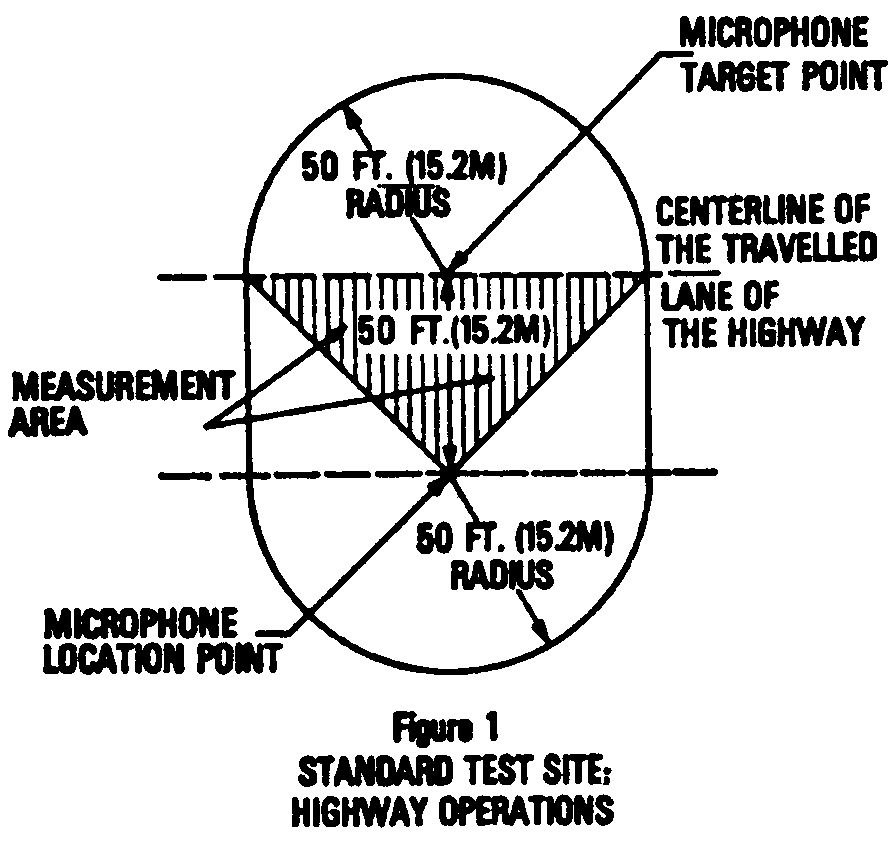
(a) Measurement shall be made at a test site which is adjacent to, and includes a portion of, a traveled lane of a public highway. A microphone target point shall be established on the centerline of the traveled lane of the highway, and a microphone location point shall be established on the ground surface not less than 31 feet (9.5m) or more than 83 feet (25.3m) from the microphone target point and on a line that is perpendicular to the centerline of the traveled lane of the highway and that passes through the microphone target point. In the case of a standard test site, the microphone location point is 50 feet (15.2m) from the microphone target point. Within the test site is a triangular measurement area. A plan view diagram of a standard test site, having an open site within a 50–foot (15.2m) radius of both the microphone target point and the microphone location point, is shown in Figure 1. Measurements may be made at a test site having smaller or greater dimensions in accordance with the rules in subpart F of this part.
(b) The test site must be an open site, essentially free of large sound-reflecting objects. However, the following objects may be within the test site, including the triangular measurement area:
(1) Small cylindrical objects such as fire hydrants or telephone or utility poles.
(2) Rural mailboxes.
(3) Traffic railings of any type of construction except solid concrete barriers (see § 325.5(c)(4)).
(4) One or more curbs having a vertical height of 1 foot (.3 m) or less.
(c) The following objects may be within the test site if they are outside of the triangular measurement area of the site:
(1) Any vertical surface (such as billboard), regardless of size, having a lower edge more than 15 feet (4.6 m) higher than the surface of the traveled lane of the highway.
(2) Any uniformly smooth sloping surface slanting away from the highway (such as a rise in grade alongside the highway) with a slope that is less than 45 degrees above the horizontal.
(3) Any surface slanting away from the highway that is 45 degrees or more and not more than 90 degrees above the horizontal, if all points on the surface are more than 15 feet (4.6 m) above the surface of the traveled lane of the highway.
(d) The surface of the ground within the measurement area must be relatively flat (see § 325.5(c)(5)). The site shall be a “soft” test site. However, if the site is determined to be “hard,” the correction factor specified in § 325.75(a) of this part shall be applied to the measurement.
(e) The traveled lane of the highway within the test site must be dry, paved with relatively smooth concrete or asphalt, and substantially free of—
(1) Holes or other defects which would cause a motor vehicle to emit irregular tire, body, or chassis impact noise; and
(2) Loose material, such as gravel or sand.
(f) The traveled lane of the highway on which the microphone target point is situated must not pass through a tunnel or underpass located within 200 feet (61 m) of that point.
Cite this article: FindLaw.com - Code of Federal Regulations Title 49. Transportation § 49.325.33 Site characteristics; highway operations - last updated January 02, 2025 | https://codes.findlaw.com/cfr/title-49-transportation/cfr-sect-49-325-33/
FindLaw Codes may not reflect the most recent version of the law in your jurisdiction. Please verify the status of the code you are researching with the state legislature before relying on it for your legal needs.
Make It a Preferred Google Search Source
Get help with your legal needs
FindLaw’s Learn About the Law features thousands of informational articles to help you understand your options. And if you’re ready to hire an attorney, find one in your area who can help.
