
Learn About The Law
Get help with your legal needs
FindLaw’s Learn About the Law features thousands of informational articles to help you understand your options. And if you’re ready to hire an attorney, find one in your area who can help.
Current as of January 02, 2025 | Updated by Findlaw Staff
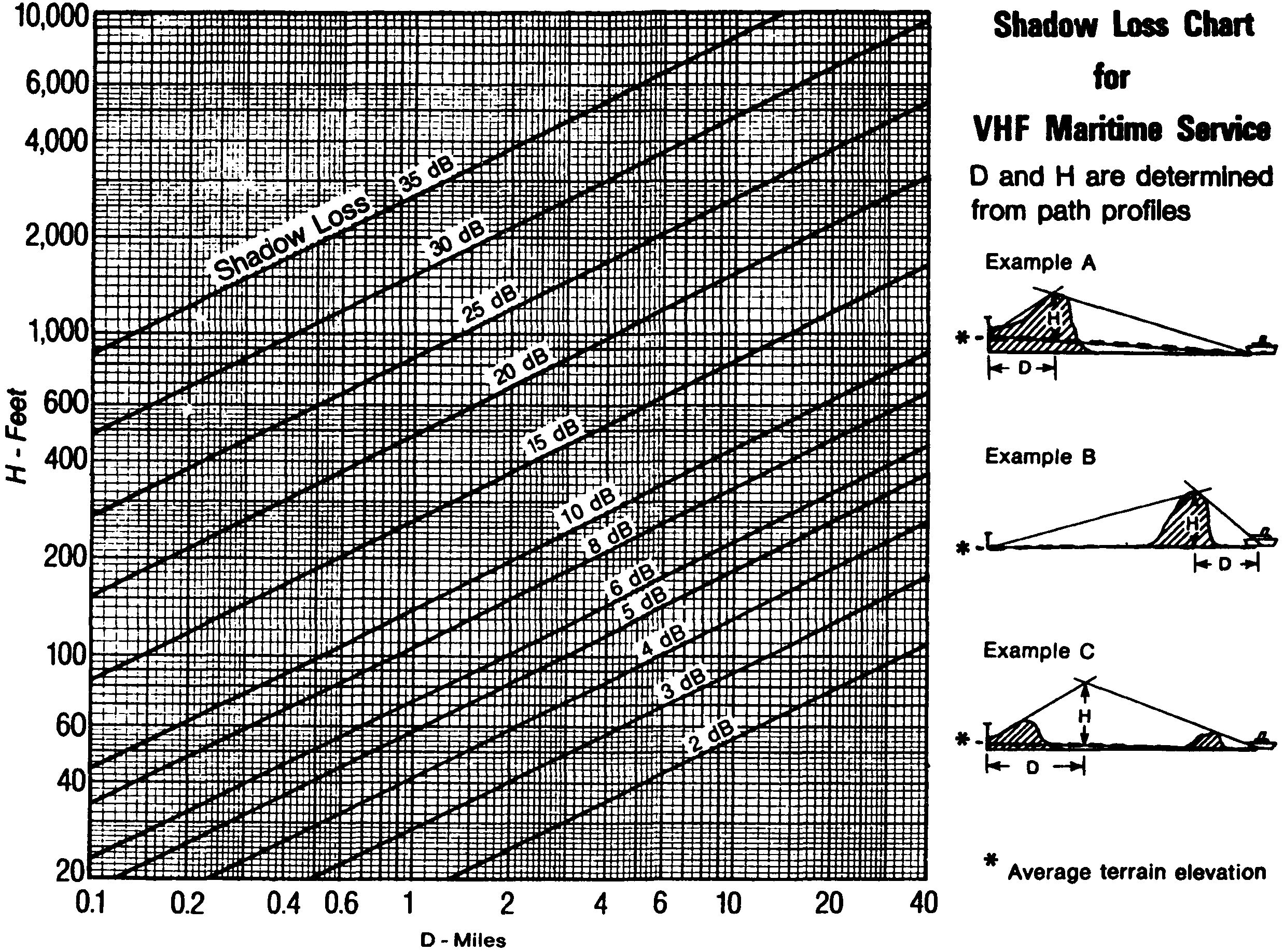
Where the transmission path is obstructed the received signal must be adjusted to include shadow loss. Attenuation due to shadowing must be taken from § 80.769 Graph 1, as follows:
(a) Inspect the map(s) to determine if a hill(s) obstructs an imaginary line of sight (dashed line on illustrative profiles of § 80.769 Graph 1 from the average terrain elevation at the coast station antenna to the water level at the ship location. If average terrain elevation exceeds the actual ground elevation at the antenna site, the latter elevation must be used as the average terrain elevation.
(b) If a hill appears to obstruct the radio path, plot the antenna site elevation, the obstruction elevation and the height of the ship station on rectangular coordinate paper using elevation above mean sea level as the vertical scale and distance in statute miles as the horizontal scale. Then draw a straight line between the antenna and the ship.
(c) If a hill obstructs the imaginary line of sight, determine its height (H) above the imaginary line and its distance (D) from either the coast or ship station, whichever is nearer, as illustrated by examples “A” and “B” on Graph 1.
(d) Read the shadow loss from this Graph 1 and subtract that loss from the computed received signal.
(e) Where more than one hill obstructs the transmission path, determine the height and position of a single equivalent hill, as illustrated by example “C” on this graph. Read the shadow loss from this graph for the equivalent hill.
Cite this article: FindLaw.com - Code of Federal Regulations Title 47. Telecommunication § 47.80.769 Shadow loss - last updated January 02, 2025 | https://codes.findlaw.com/cfr/title-47-telecommunication/cfr-sect-47-80-769/
FindLaw Codes may not reflect the most recent version of the law in your jurisdiction. Please verify the status of the code you are researching with the state legislature before relying on it for your legal needs.
Get help with your legal needs
FindLaw’s Learn About the Law features thousands of informational articles to help you understand your options. And if you’re ready to hire an attorney, find one in your area who can help.
