
Learn About The Law
Get help with your legal needs
FindLaw’s Learn About the Law features thousands of informational articles to help you understand your options. And if you’re ready to hire an attorney, find one in your area who can help.
Current as of January 02, 2025 | Updated by Findlaw Staff
(a) By-product hydrogen streams and end box ventilation system vents. For each consecutive 52–week period, you must determine the g Hg/Mg Cl2 produced from all by-product hydrogen streams and all end box ventilation system vents, if applicable, at a mercury cell chlor-alkali production facility using the procedures in paragraphs (a)(1) through (3) of this section. You must begin collecting data on the compliance date that is specified in § 63.8186 for your affected source and calculate your first 52–week average mercury emission rate at the end of the 52nd week after the compliance date.
(1) Each week, you must determine the weekly mercury emission rate in grams per week for each by-product hydrogen stream and for each end box ventilation system vent, if applicable, using one of the monitoring options in paragraph (a)(1)(i) or (ii) of this section.
(i) Continuous mercury monitoring according to §§ 63.8242 and 63.8244(a).
(ii) Periodic monitoring according to § 63.8244(b).
(2) Each week, you must determine the chlorine production and keep records of the production rate as required under § 63.8256(b)(6).
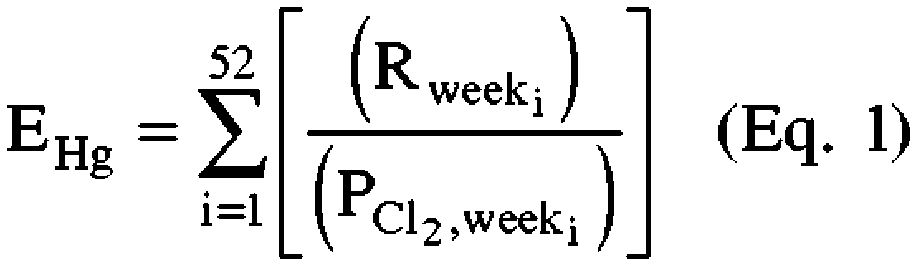
(3) Beginning 52 weeks after the compliance date specified in § 63.8186 for your affected source, you must calculate the 52–week average mercury emission rate from all by-product hydrogen steam and all end box ventilation system vents, if applicable, using Equation 1 of this section as follows:
Where:
EHg = 52–week average mercury emission rate for weeki, g Hg/Mg Cl2;
Rweek, i = Mercury emission rate for weeki from paragraph (a)(1) of this section, g Hg per week;
PCl2, weeki = Amount of chlorine produced during weeki, from paragraph (a)(2) of this section, Mg Cl2 per week.
(b) Mercury thermal recovery units. If you choose the continuous monitoring option in § 63.8240(a), you must demonstrate continuous compliance using paragraph (b)(1) of this section. If you choose the periodic monitoring option in § 63.8240(b), you must demonstrate continuous compliance using paragraph (b)(2) of this section.
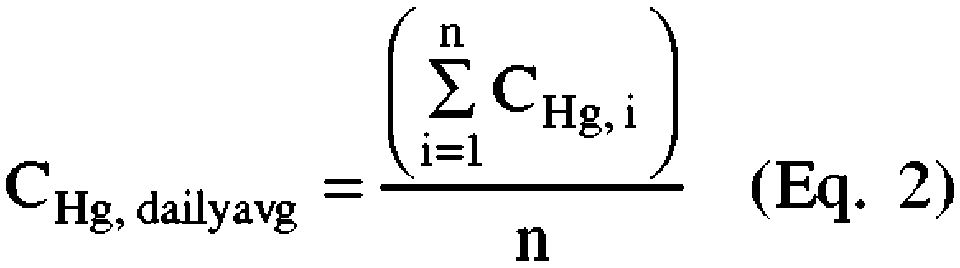
(1) You must calculate the daily average mercury concentration using Equation 2 of this section as follows:
Where:
CHg, dailyavg = Average mercury concentration for the operating day, milligrams per dry standard cubic meter;
CHg,i = Concentration of mercury measured at the interval i (i.e., 15 minute reading) using a mercury continuous emission monitor, milligrams per dry standard cubic meter; and
n = Number of concentration measurements taken during the operating day.
(2) You must calculate the daily average mercury concentration using the procedures in § 63.8234(b).
Cite this article: FindLaw.com - Code of Federal Regulations Title 40. Protection of Environment § 40.63.8243 What equations and procedures must I use to demonstrate continuous compliance? - last updated January 02, 2025 | https://codes.findlaw.com/cfr/title-40-protection-of-environment/cfr-sect-40-63-8243/
FindLaw Codes may not reflect the most recent version of the law in your jurisdiction. Please verify the status of the code you are researching with the state legislature before relying on it for your legal needs.
Get help with your legal needs
FindLaw’s Learn About the Law features thousands of informational articles to help you understand your options. And if you’re ready to hire an attorney, find one in your area who can help.
