
Learn About The Law
Get help with your legal needs
FindLaw’s Learn About the Law features thousands of informational articles to help you understand your options. And if you’re ready to hire an attorney, find one in your area who can help.
Current as of January 02, 2025 | Updated by Findlaw Staff
(a) To determine that your well is a low pressure well subject to § 60.5375a(f), you must determine whether the characteristics of the well are such that the well meets the definition of low pressure well in § 60.5430a. To determine that the well meets the definition of low pressure well in § 60.5430a, you must use the low pressure well equation below:
Where:
(1) PL is the pressure of flowback fluid immediately before it enters the flow line, expressed in pounds force per square inch (psia), and is to be calculated using the equation above;
(2) PR is the pressure of the reservoir containing oil, gas, and water at the well site, expressed in psia;
(3) Lis the true vertical depth of the well, expressed in feet (ft);
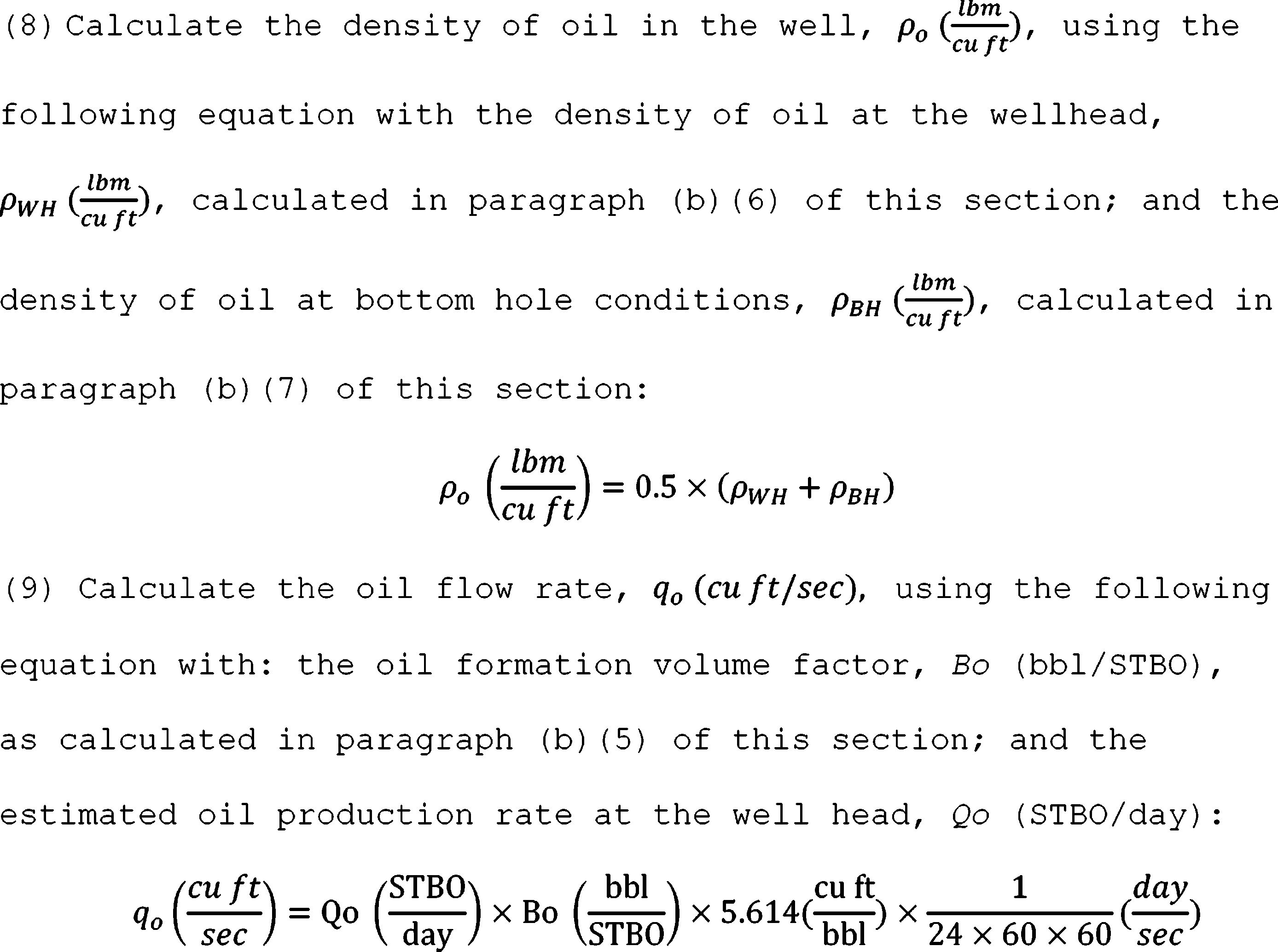
(4) qo is the flow rate of oil in the well, expressed in cubic feet/second (cu ft/sec);
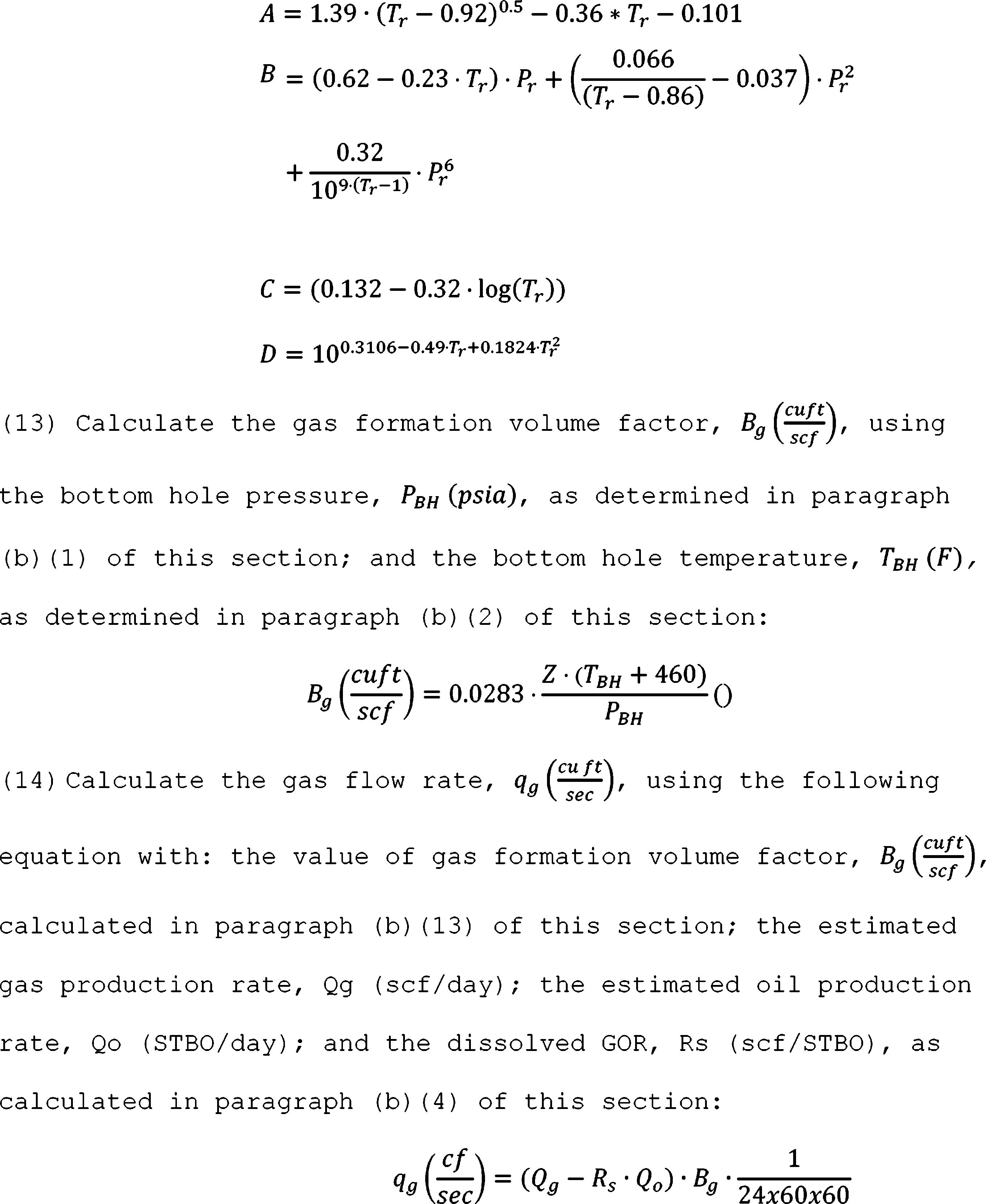
(5) qg is the flow rate of gas in the well, expressed in cu ft/sec;
(6) qw is the flow rate of water in the well, expressed in cu ft/sec;
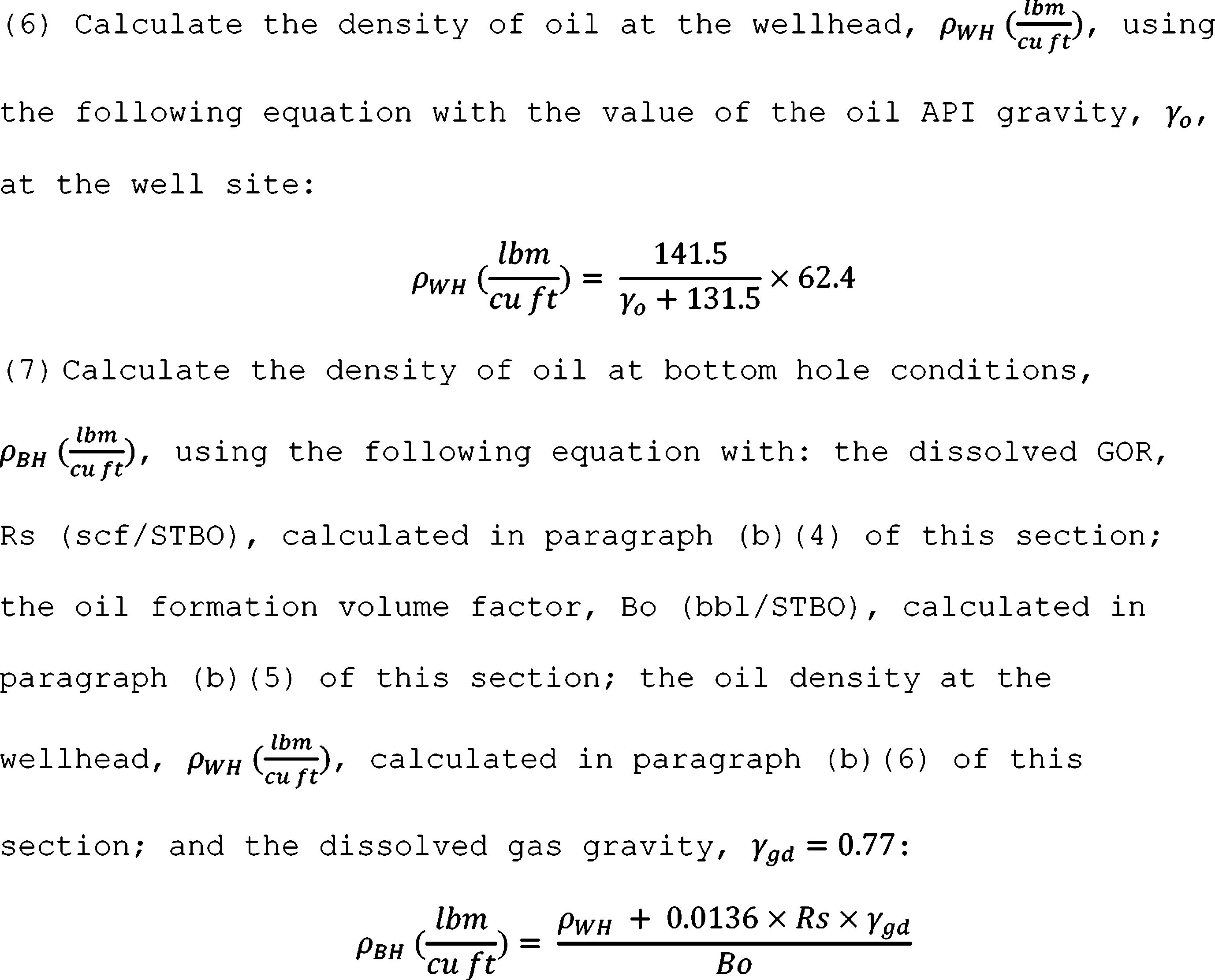
(7) ρo is the density of oil in the well, expressed in pounds mass per cubic feet (lbm/cu ft).
(b) You must determine the four values in paragraphs (a)(4) through (7) of this section, using the calculations in paragraphs (b)(1) through (b)(15) of this section.
(1) Determine the value of the bottom hole pressure, PBH (psia), based on available information at the well site, or by calculating it using the reservoir pressure, PR (psia), in the following equation:
(2) Determine the value of the bottom hole temperature, TBH (F), based on available information at the well site, or by calculating it using the true vertical depth of the well, L (ft), in the following equation:
TBH (F) = (0.014 x L) + 79.081
(3) Calculate the value of the applicable natural gas specific gravity that would result from a separator pressure of 100 psig, γgs, using the following equation with: Separator at standard conditions (pressure, p = 14.7 (psia), temperature, T = 60 (F)); the oil API gravity at the well site, γ0; and the gas specific gravity at the separator under standard conditions, γgp = 0.75:
(4) Calculate the value of the applicable dissolved GOR, Rs (scf/STBO), using the following equation with: The bottom hole pressure, PBH (psia), determined in (b)(1) of this section; the bottom hole temperature, TBH (F), determined in (b)(2) of this section; the gas gravity at separator pressure of 100 psig, γgs, calculated in (b)(3) of this section; the oil API gravity, γo, at the well site; and the constants, C1, C2, and C3, found in Table A:
|
Table A—Coefficients for the correlation for Rs |
||
|---|---|---|
|
Constant |
γAPI ≤ 30 |
γAPI > 30 |
|
C1 |
0.0362 |
0.0178 |
|
C2 |
1.0937 |
1.1870 |
|
C3 |
25.7240 |
23.931 |
(5) Calculate the value of the oil formation volume factor, Bo (bbl/STBO), using the following equation with: the bottom hole temperature, TBH (F), determined in paragraph (b)(2) of this section; the gas gravity at separator pressure of 100 psig, γgs, calculated in paragraph (b)(3) of this section; the dissolved GOR, Rs (scf/STBO), calculated in paragraph (b)(4) of this section; the oil API gravity, γo, at the well site; and the constants, C1, C2, and C3, found in Table B:
|
Table B—Coefficients for the Correlation for Bo |
||
|---|---|---|
|
Constant |
γAPI ≤ 30 |
γAPI > 30 |
|
C1 |
4.677 x 10 -4 |
4.670 x 10 -4 |
|
C2 |
1.751 x 10 -5 |
1.100 x 10 -5 |
|
C3 |
-1.811 x 10 -8 |
1.337 x 10 -9 |
(10) Calculate the critical pressure, Pc (psia), and critical temperature, Tc (R), using the equations below with: Gas gravity at standard conditions (pressure, P = 14.7 (psia), temperature, T = 60 (F)), γ = 0.75; and where the mole fractions of nitrogen, carbon dioxide and hydrogen sulfide in the gas are XN2 = 0.168225, XCO2 = 0.013163, and XH2S = 0.013680, respectively:
Pc (psia) = 678 - 50 · (γg - 0.5) - 206.7 · XN2 + 440 · XCO2 + 606.7 · XH2S
Tc(R) = 326 + 315.7 · (γg - 0.5) - 240 · XN2 - 88.3 · XCO2 + 133.3 · XH2S
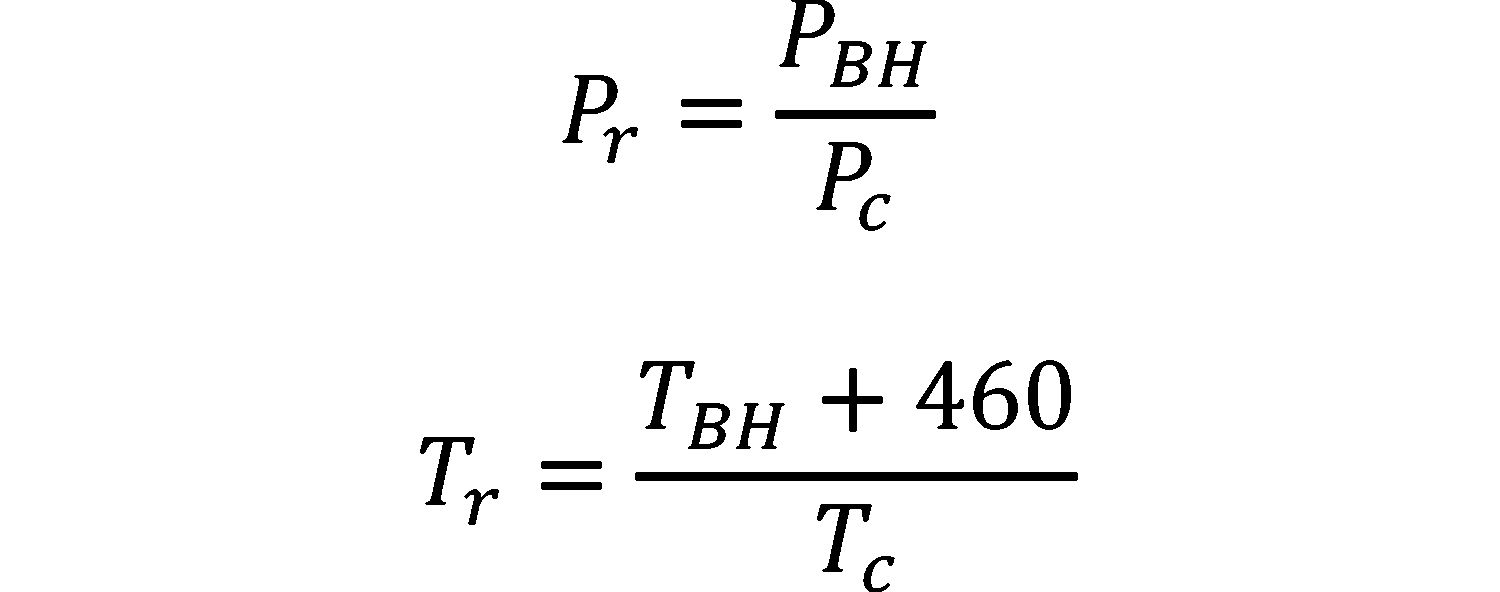
(11) Calculate reduced pressure, Pr, and reduced temperature, Tr, using the following equations with: the bottom hole pressure, PBH, as determined in paragraph (b)(1) of this section; the bottom hole temperature, TBH (F), as determined in paragraph (b)(2) of this section in the following equations:
(12)(i) Calculate the gas compressibility factor, Z, using the following equation with the reduced pressure, Pr, calculated in paragraph (b)(11) of this section:
(ii) The values for A, B, C, D in the above equation, are calculated using the following equations with the reduced pressure, Pr, and reduced temperature, Tr, calculated in paragraph (b)(11) of this section:
(15) Calculate the flow rate of water in the well, qw (cu ft/sec), using the following equation with the water production rate Qw (bbl/day) at the well site:







Cite this article: FindLaw.com - Code of Federal Regulations Title 40. Protection of Environment § 40.60.5432a How do I determine whether a well is a low pressure well using the low pressure well equation? - last updated January 02, 2025 | https://codes.findlaw.com/cfr/title-40-protection-of-environment/cfr-sect-40-60-5432a/
FindLaw Codes may not reflect the most recent version of the law in your jurisdiction. Please verify the status of the code you are researching with the state legislature before relying on it for your legal needs.
Get help with your legal needs
FindLaw’s Learn About the Law features thousands of informational articles to help you understand your options. And if you’re ready to hire an attorney, find one in your area who can help.
