
Learn About The Law
Get help with your legal needs
FindLaw’s Learn About the Law features thousands of informational articles to help you understand your options. And if you’re ready to hire an attorney, find one in your area who can help.
Current as of January 02, 2025 | Updated by Findlaw Staff
(a) General. Correct PM sample media for their buoyancy in air if you weigh them on a balance. The buoyancy correction depends on the sample media density, the density of air, and the density of the calibration weight used to calibrate the balance. The buoyancy correction does not account for the buoyancy of the PM itself, because the mass of PM typically accounts for only (0.01 to 0.10)% of the total weight. A correction to this small fraction of mass would be at the most 0.010%.
(b) PM sample media density. Different PM sample media have different densities. Use the known density of your sample media, or use one of the densities for some common sampling media, as follows:
(1) For PTFE–coated borosilicate glass, use a sample media density of 2300 kg/m3 .
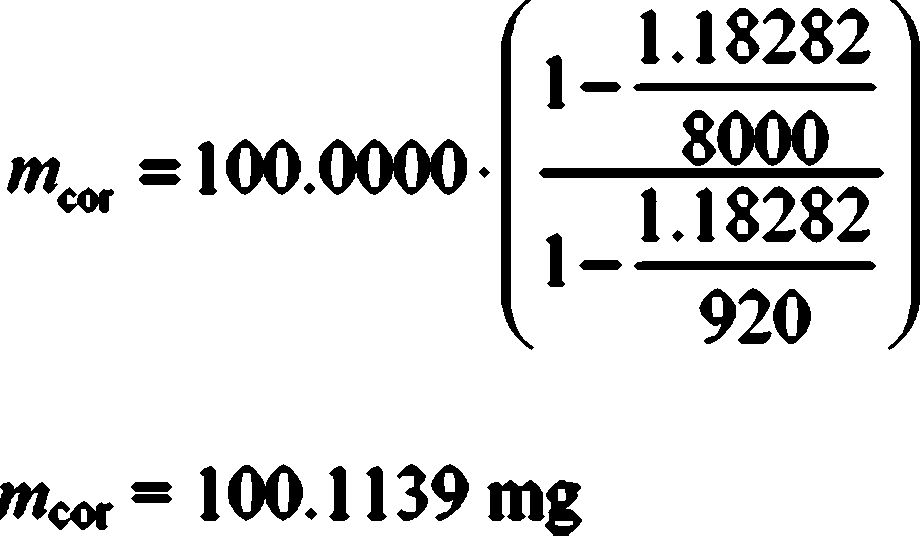
(2) For PTFE membrane (film) media with an integral support ring of polymethylpentene that accounts for 95% of the media mass, use a sample media density of 920 kg/m3.
(3) For PTFE membrane (film) media with an integral support ring of PTFE, use a sample media density of 2144 kg/m3.
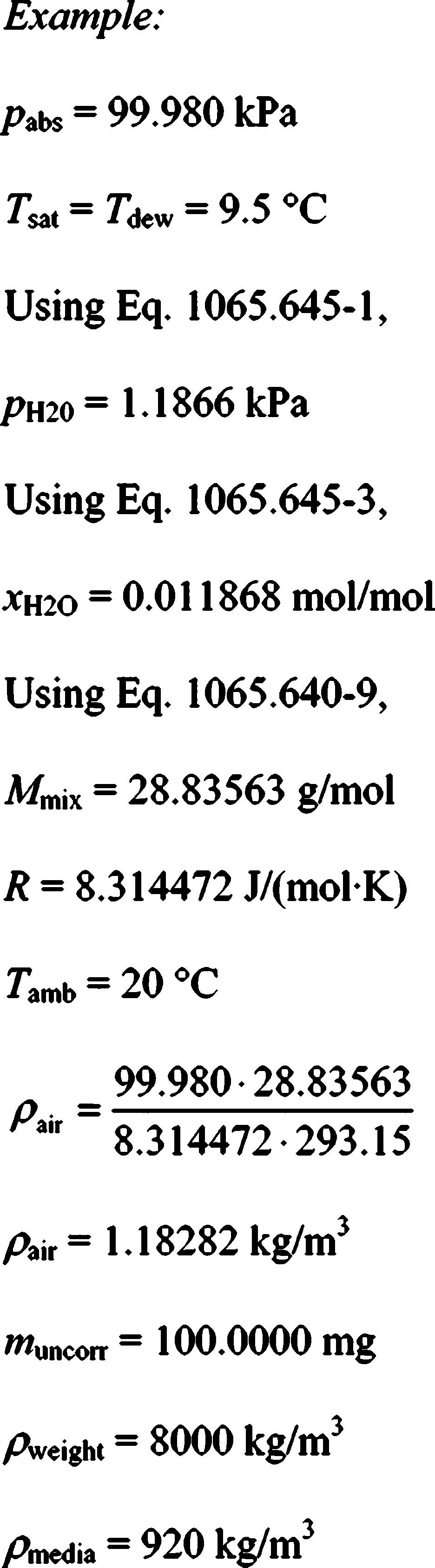
(c) Air density. Because a PM balance environment must be tightly controlled to an ambient temperature of (22 ±1) °C and humidity has an insignificant effect on buoyancy correction, air density is primarily a function of atmospheric pressure. Therefore you may use nominal constant values for temperature and humidity when determining the air density of the balance environment in Eq. 1065.690–2.
(d) Calibration weight density. Use the stated density of the material of your metal calibration weight. The example calculation in this section uses a density of 8000 kg/m3, but you should know the density of your weight from the calibration weight supplier or the balance manufacturer if it is an internal weight.
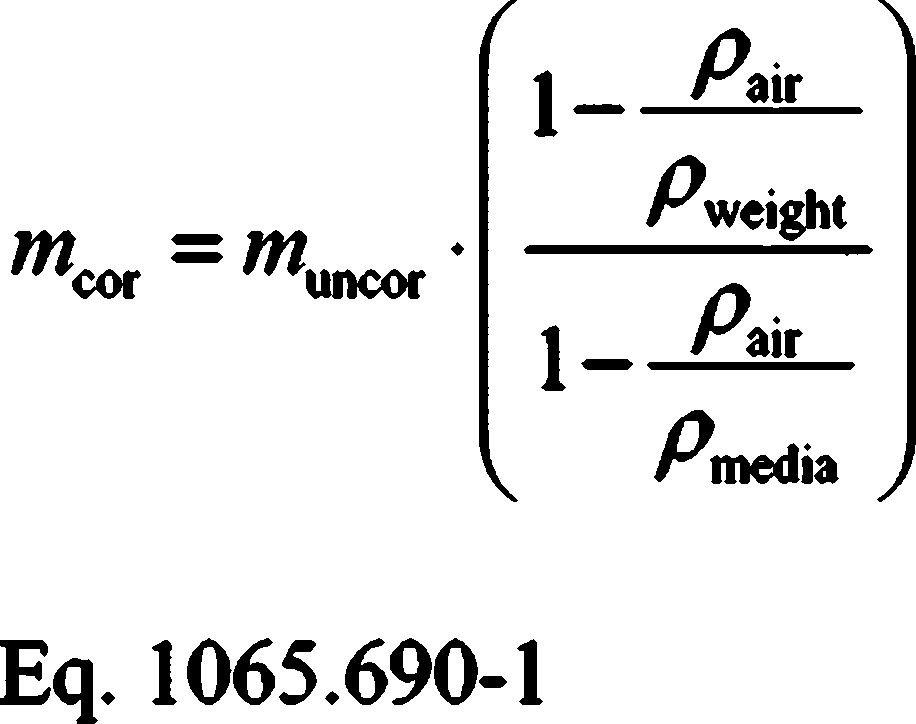
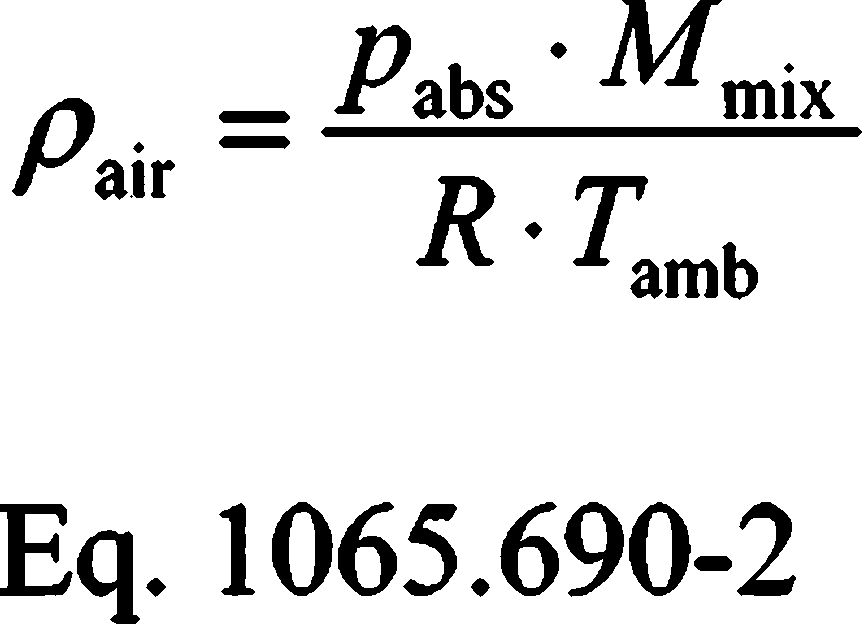
(e) Correction calculation. Correct the PM sample media for buoyancy using the following equations:
Where:
m cor = PM mass corrected for buoyancy.
m uncor = PM mass uncorrected for buoyancy.
ρ air = density of air in balance environment.
ρ weight = density of calibration weight used to span balance.
ρ media = density of PM sample media, such as a filter.
Where:
p abs = absolute pressure in balance environment.
M mix = molar mass of air in balance environment.
R = molar gas constant.
Tamb = absolute ambient temperature of balance environment.
Cite this article: FindLaw.com - Code of Federal Regulations Title 40. Protection of Environment § 40.1065.690 Buoyancy correction for PM sample media - last updated January 02, 2025 | https://codes.findlaw.com/cfr/title-40-protection-of-environment/cfr-sect-40-1065-690/
FindLaw Codes may not reflect the most recent version of the law in your jurisdiction. Please verify the status of the code you are researching with the state legislature before relying on it for your legal needs.
Get help with your legal needs
FindLaw’s Learn About the Law features thousands of informational articles to help you understand your options. And if you’re ready to hire an attorney, find one in your area who can help.
