
Learn About The Law
Get help with your legal needs
FindLaw’s Learn About the Law features thousands of informational articles to help you understand your options. And if you’re ready to hire an attorney, find one in your area who can help.
Current as of January 02, 2025 | Updated by Findlaw Staff
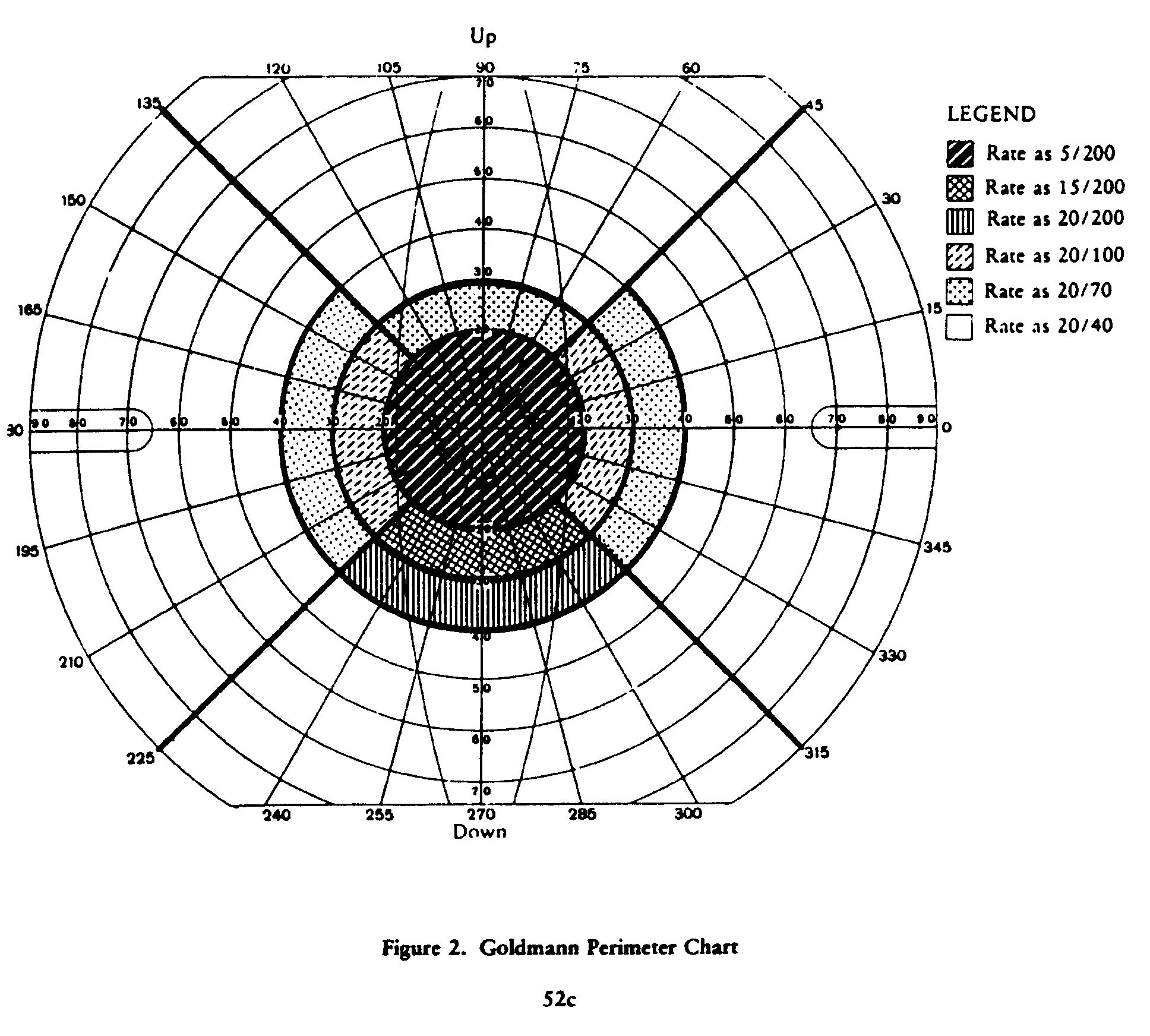
(a) Examination of visual fields. Examiners must use either Goldmann kinetic perimetry or automated perimetry using Humphrey Model 750, Octopus Model 101, or later versions of these perimetric devices with simulated kinetic Goldmann testing capability. For phakic (normal) individuals, as well as for pseudophakic or aphakic individuals who are well adapted to intraocular lens implant or contact lens correction, visual field examinations must be conducted using a standard target size and luminance, which is Goldmann's equivalent III/4e. For aphakic individuals not well adapted to contact lens correction or pseudophakic individuals not well adapted to intraocular lens implant, visual field examinations must be conducted using Goldmann's equivalent IV/4e. The examiner must document the results for at least 16 meridians 22 1/2 degrees apart for each eye and indicate the Goldmann equivalent used. See Table III for the normal extent (in degrees) of the visual fields at the 8 principal meridians (45 degrees apart). When the examiner indicates that additional testing is necessary to evaluate visual fields, the additional testing must be conducted using either a tangent screen or a 30–degree threshold visual field with the Goldmann III stimulus size. The examination report must document the results of either the tangent screen or of the 30–degree threshold visual field with the Goldmann III stimulus size.
(b) Evaluation of visual fields. Determine the average concentric contraction of the visual field of each eye by measuring the remaining visual field (in degrees) at each of eight principal meridians 45 degrees apart, adding them, and dividing the sum by eight.
(c) Combination of visual field defect and decreased visual acuity. To determine the evaluation for visual impairment when both decreased visual acuity and visual field defect are present in one or both eyes and are service connected, separately evaluate the visual acuity and visual field defect (expressed as a level of visual acuity), and combine them under the provisions of § 4.25.
(Authority: 38 U.S.C. 1155)
Cite this article: FindLaw.com - Code of Federal Regulations Title 38. Pensions, Bonuses, and Veterans' Relief § 38.4.77 Visual fields - last updated January 02, 2025 | https://codes.findlaw.com/cfr/title-38-pensions-bonuses-and-veterans-relief/cfr-sect-38-4-77/
FindLaw Codes may not reflect the most recent version of the law in your jurisdiction. Please verify the status of the code you are researching with the state legislature before relying on it for your legal needs.
Get help with your legal needs
FindLaw’s Learn About the Law features thousands of informational articles to help you understand your options. And if you’re ready to hire an attorney, find one in your area who can help.
