
Learn About The Law
Get help with your legal needs
FindLaw’s Learn About the Law features thousands of informational articles to help you understand your options. And if you’re ready to hire an attorney, find one in your area who can help.
Current as of January 02, 2025 | Updated by Findlaw Staff
(a) Conditions of use. Tramming the continuous mining machine in and out of the mine and from section to section must be done in accordance with movement requirements of high-voltage power centers and portable transformers (§ 75.812) and as follows:
(1) The power source must not be located in areas where permissible equipment is required;
(2) The continuous mining machine must not be used for mining or cutting purposes, unless a power center is used in accordance with §§ 75.823 through 75.828 and §§ 75.830 through 75.833;
(3) Low-, medium-, and high-voltage cables must comply with §§ 75.600–1, 75.907, and 75.826, as applicable; and
(4) The energized high-voltage cable must be mechanically secured onboard the continuous mining machine. This provision applies only when using the power sources specified in paragraphs (c)(2) and (c)(3) of this section.
(b) Testing prior to tramming. Prior to tramming the continuous mining machine,
(1) A qualified person must activate the ground-fault and ground-wire monitor test circuits of the power sources specified in paragraph (c) of this section to assure that the corresponding circuit-interrupting device opens the circuit. Corrective actions and recordkeeping resulting from these tests must be in accordance with §§ 75.832(f) and (g).
(2) Where applicable, a person designated by the mine operator must activate the test circuit for the grounded-phase detection circuit on the continuous mining machine to assure that the detection circuit is functioning properly. Corrective actions resulting from this test must be in accordance with § 75.832(f).
(c) Power sources. In addition to the power center specified in § 75.825, the following power sources may be used to tram the continuous mining machine.
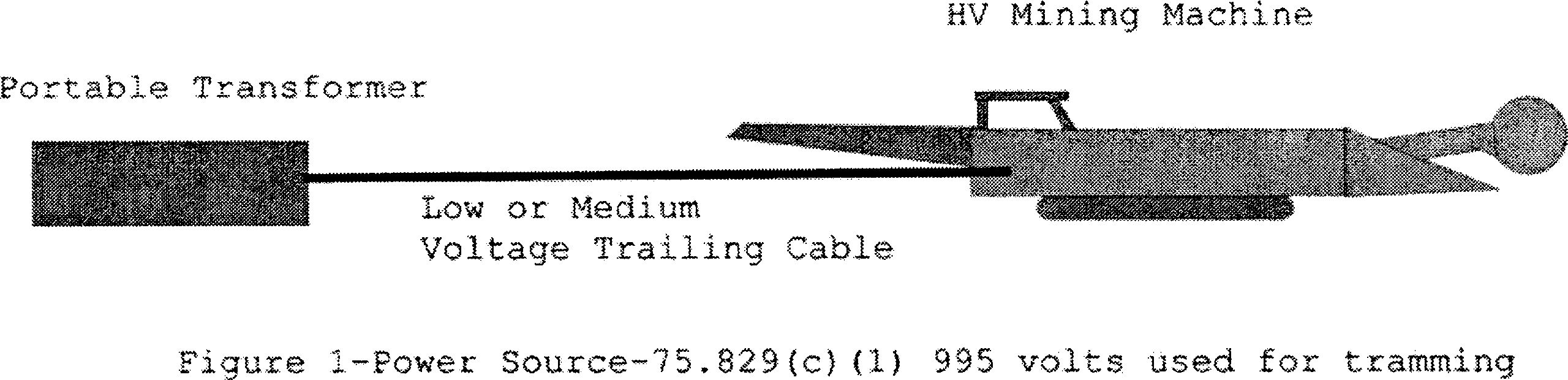
(1) Medium-voltage power source. A medium-voltage power source is a source that supplies 995 volts through a trailing cable (See Figure 1 of this section) to the continuous mining machine. The medium-voltage power source must—
(i) Not be used to back-feed the high-voltage circuits of the continuous mining machine; and
(ii) Meet all applicable requirements for medium-voltage circuits in 30 CFR 75.
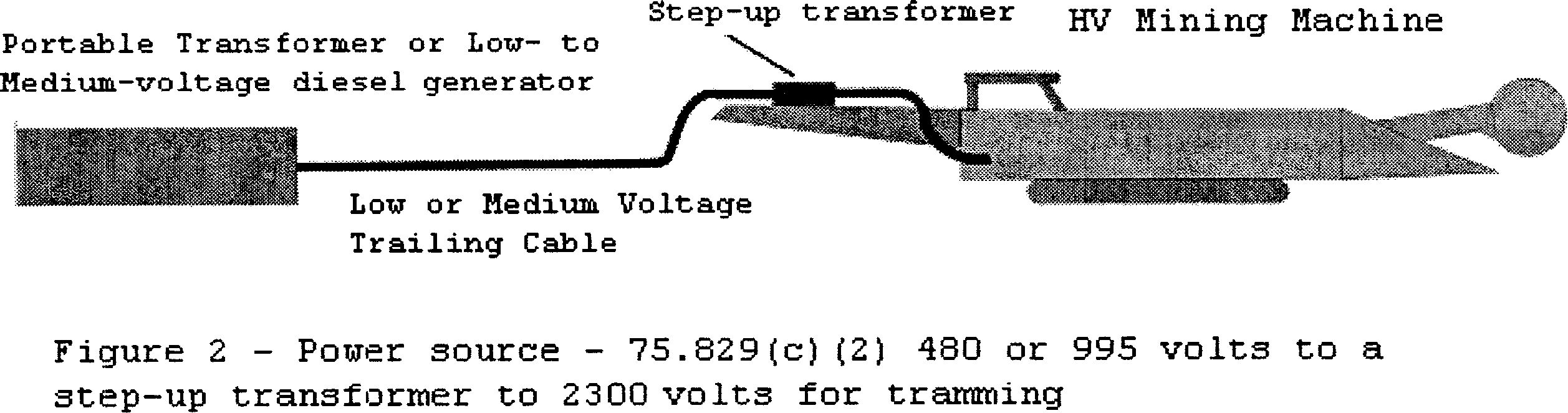
(2) Step-up transformer. A step-up transformer is a transformer that steps up the low or medium voltage to high voltage (See Figure 2 in this section) and must meet the following requirements:
(i) The trailing cable supplying low or medium voltage to the step-up transformer must meet the applicable requirements of 30 CFR part 75;
(ii) The high-voltage circuit output of the step-up transformer supplying power to the continuous mining machine must meet the applicable provisions of § 75.824;
(iii) The step-up transformer enclosure must be—
(A) Securely mounted to minimize vibration on:
(1) The continuous mining machine; or
(2) A sled/cart that must be connected to the continuous mining machine by a tow-bar and be in close proximity to the mining machine.
(B) Grounded as follows:
(1) Connected to the incoming ground conductor of the low- or medium-voltage trailing cable;
(2) Bonded by a No. 1/0 A.W.G. or larger external grounding conductor to the continuous mining machine frame; and
(3) Bonded by a No. 1/0 A.W.G. or larger external grounding conductor to the metallic shell of each cable coupler.
(C) Equipped with:
(1) At least two interlock switches for each of the enclosure covers; and
(2) An external emergency stop switch to remove input power to the step-up transformer.
Cite this article: FindLaw.com - Code of Federal Regulations Title 30. Mineral Resources § 30.75.829 Tramming continuous mining machines in and out of the mine and from section to section - last updated January 02, 2025 | https://codes.findlaw.com/cfr/title-30-mineral-resources/cfr-sect-30-75-829/
FindLaw Codes may not reflect the most recent version of the law in your jurisdiction. Please verify the status of the code you are researching with the state legislature before relying on it for your legal needs.
Make It a Preferred Google Search Source
Get help with your legal needs
FindLaw’s Learn About the Law features thousands of informational articles to help you understand your options. And if you’re ready to hire an attorney, find one in your area who can help.
