
Learn About The Law
Get help with your legal needs
FindLaw’s Learn About the Law features thousands of informational articles to help you understand your options. And if you’re ready to hire an attorney, find one in your area who can help.
Current as of January 02, 2025 | Updated by Findlaw Staff
a. Samples to be taken—In order to ascertain equivalency, it is necessary to collect a total of 100 samples from at least 10 sites in a mill. That is, there should be 10 replicate readings at each of 10 sites. The sites should represent dust levels which vary over the allowable range of 0.5 to 2 times the permissible exposure limit. Each sample requires the use of two vertical elutriators (VE's) and at least one but not more than two alternative devices (AD's). Thus, the end result is 200 VE readings and either 100 or 200 AD readings. The 2 VE readings and the 1 or 2 AD readings at each time and site must be made simultaneously. That is, the two VE's and one or two AD's must be arranged together in such a way that they are measuring essentially the same dust levels.
b. Data averaging—The two VE readings taken at each site are then averaged. These averages are to be used as the 100 VE readings. If two alternate devices were used, their test results are also averaged. Thus, after this step is accomplished, there will be 100 VE readings and 100 AD readings.
c. Differences—For each of the 100 sets of measurements (VE and AD) the difference is obtained as the average VE reading minus the AD reading. Call these differences Di. Thus, we have.
Di = VEi − ADi, i = 1,2, . . . , 100 (1)
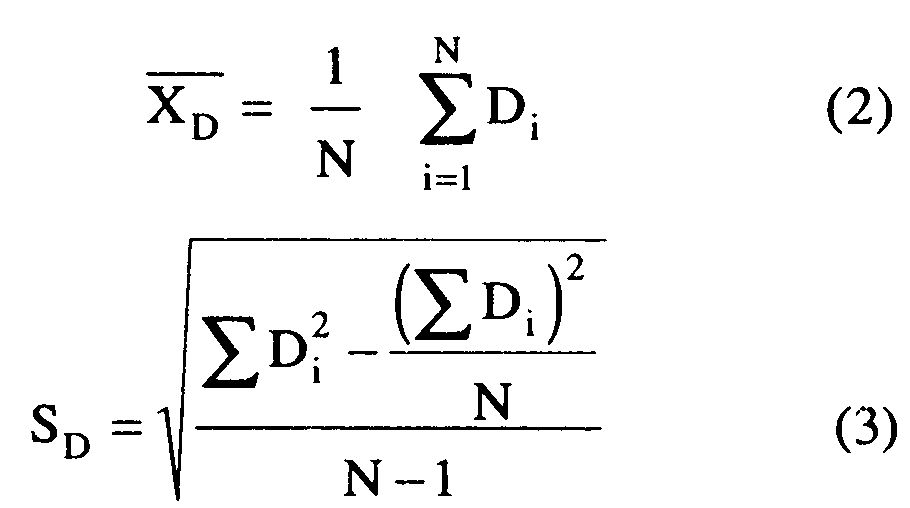
Next we compute the arithmetic mean and standard deviations of the differences, using equations (2) and (3), respectively.
where N equals the number of differences (100 in this case), XD is the arithmetic mean and SD is the standard deviation.
We next calculate the critical value as T = KSD + |X|D| where K = 1.87, based on 100 samples.
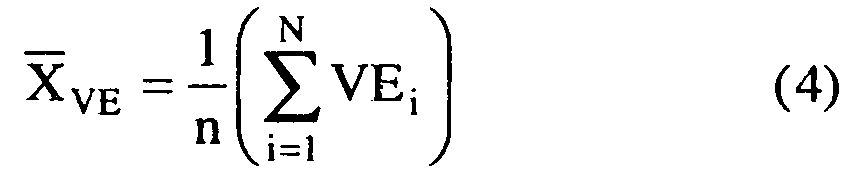
d. Equivalency test. The next step is to obtain the average of the 100 VE readings. This is obtained by equation (4)
We next multiply 0.25 by XVE. If T ≤ 0.25 XVE, we can say that the alternate device has passed the equivalency test.
Cite this article: FindLaw.com - Code of Federal Regulations Title 29. Labor § 29.1910.1043—Vertical Elutriator Equivalency Protocol - last updated January 02, 2025 | https://codes.findlaw.com/cfr/title-29-labor/cfr-sect-29-1910-1043-app-e/
FindLaw Codes may not reflect the most recent version of the law in your jurisdiction. Please verify the status of the code you are researching with the state legislature before relying on it for your legal needs.
Get help with your legal needs
FindLaw’s Learn About the Law features thousands of informational articles to help you understand your options. And if you’re ready to hire an attorney, find one in your area who can help.
