
Learn About The Law
Get help with your legal needs
FindLaw’s Learn About the Law features thousands of informational articles to help you understand your options. And if you’re ready to hire an attorney, find one in your area who can help.
Current as of January 02, 2025 | Updated by Findlaw Staff
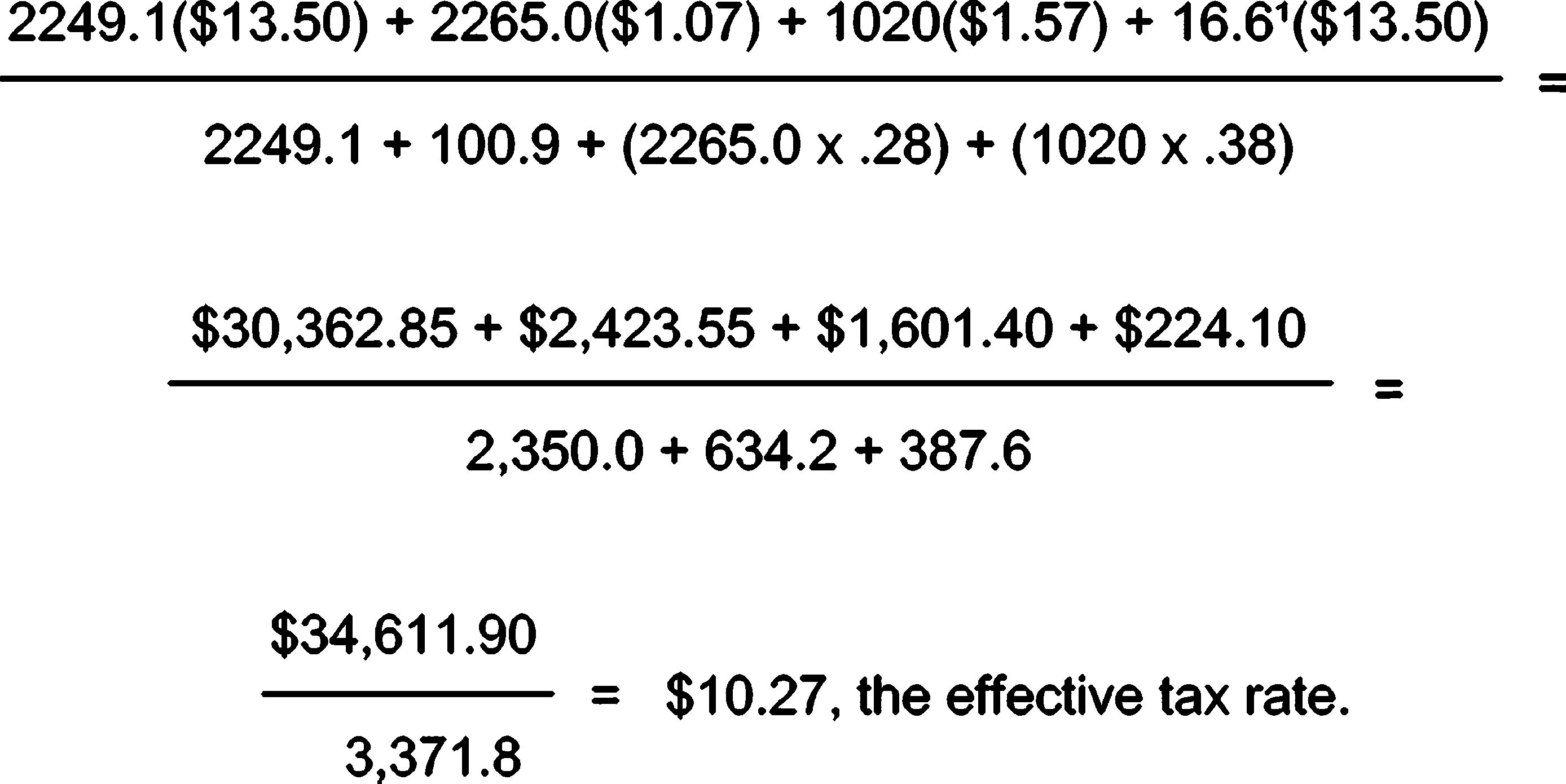
(a) How to compute effective tax rates. In order to determine the effective tax rate for a distilled spirits product containing eligible wine or eligible flavor, the proprietor must first determine the total excise taxes due on the product from all sources including distilled spirits, eligible wine, and alcohol from eligible flavors in excess of 2.5 percent of the total proof gallons in the product. Then, the proprietor must determine the total number of proof gallons of alcohol in the product regardless of the source. By dividing the total tax (numerator) by the total number of proof gallons (denominator) the proprietor will arrive at the effective tax rate for the product in dollars per proof gallon. The proprietor will compute the effective tax rate according to the following formula:
(1) Numerator. The numerator will be the sum of:
(i) The proof gallons of all distilled spirits used in the product (exclusive of distilled spirits derived from eligible flavors), multiplied by the tax rate prescribed by 26 U.S.C. 5001;
(ii) The wine gallons of each eligible wine used in the product, multiplied by the tax rate prescribed by 26 U.S.C. 5041(b)(1), (2), or (3), that would be imposed on the wine but for its removal to bonded premises. Three different tax classes of wine are eligible for the tax credit. The proprietor will have to repeat this step for each different tax class of eligible wine used; and
(iii) The proof gallons of all distilled spirits derived from eligible flavors used in the product, multiplied by the tax rate prescribed by 26 U.S.C. 5001, but only to the extent that such distilled spirits exceed 2.5 percent of the denominator prescribed in paragraph (a)(2) of this section.
(2) Denominator. The denominator will be the sum of:
(i) The proof gallons of all distilled spirits used in the product, including distilled spirits derived from eligible flavors; and
(ii) The wine gallons of each eligible wine used in the product, multiplied by twice the percentage of alcohol by volume of each, divided by 100.
(b) Rounding numbers—
(1) Proof gallons. When determining the effective tax rate, the proprietor must express quantities of distilled spirits, eligible wine, and eligible flavors to the nearest tenth of a proof gallon.
(2) Tax rates. The proprietor may round the effective tax rate to as many decimal places as the proprietor deems appropriate, provided that the rate is expressed no less exactly than the rate rounded to the nearest whole cent. The proprietor must be consistent and round the effective tax rates for all products to the same number of decimal places. When rounding, if the number to the right of the last decimal place to be kept is less than five, it will be dropped, if it is five or over, a unit will be added.
(c) Example. The following is an example of the use of the formula.
1 Proof gallons by which distilled spirits derived from eligible flavors exceed 2.5% of the total proof gallons in the batch (100.9 - (2.5% x 3,371.8) = 16.6).
|
Batch Record |
|
|---|---|
|
Distilled spirits |
2249.1 proof gallons. |
|
Eligible wine (14% alcohol by volume) |
2265.0 wine gallons. |
|
Eligible wine (19% alcohol by volume) |
1020.0 wine gallons. |
|
Eligible flavors |
100.9 proof gallons. |
(Authority: 26 U.S.C. 5010)
Cite this article: FindLaw.com - Code of Federal Regulations Title 27. Alcohol, Tobacco Products and Firearms § 27.19.246 Computing the effective tax rate for a product - last updated January 02, 2025 | https://codes.findlaw.com/cfr/title-27-alcohol-tobacco-products-and-firearms/cfr-sect-27-19-246/
FindLaw Codes may not reflect the most recent version of the law in your jurisdiction. Please verify the status of the code you are researching with the state legislature before relying on it for your legal needs.
Make It a Preferred Google Search Source
Get help with your legal needs
FindLaw’s Learn About the Law features thousands of informational articles to help you understand your options. And if you’re ready to hire an attorney, find one in your area who can help.
