
Learn About The Law
Get help with your legal needs
FindLaw’s Learn About the Law features thousands of informational articles to help you understand your options. And if you’re ready to hire an attorney, find one in your area who can help.
Current as of January 02, 2025 | Updated by Findlaw Staff
1. Sound Level. The quantity in decibels measured with an instrument satisfying requirements of American National Standard Specification for Type 1 Sound Level Meters S1.4–1971. Fast time-averaging and A-frequency weighting are to be used, unless others are specified. The sound level meter with the A-weighting is progressively less sensitive to sounds of frequency below 1,000 hertz (cycles per second), somewhat as is the ear. With fast time averaging the sound level meter responds particularly to recent sounds almost as quickly as does the ear in judging the loudness of a sound.
2. Average Sound Level. Average sound level, in decibels, is the level of the mean-square A-weighted sound pressure during the stated time period, with reference to the square of the standard reference sound pressure of 20 micropascals.
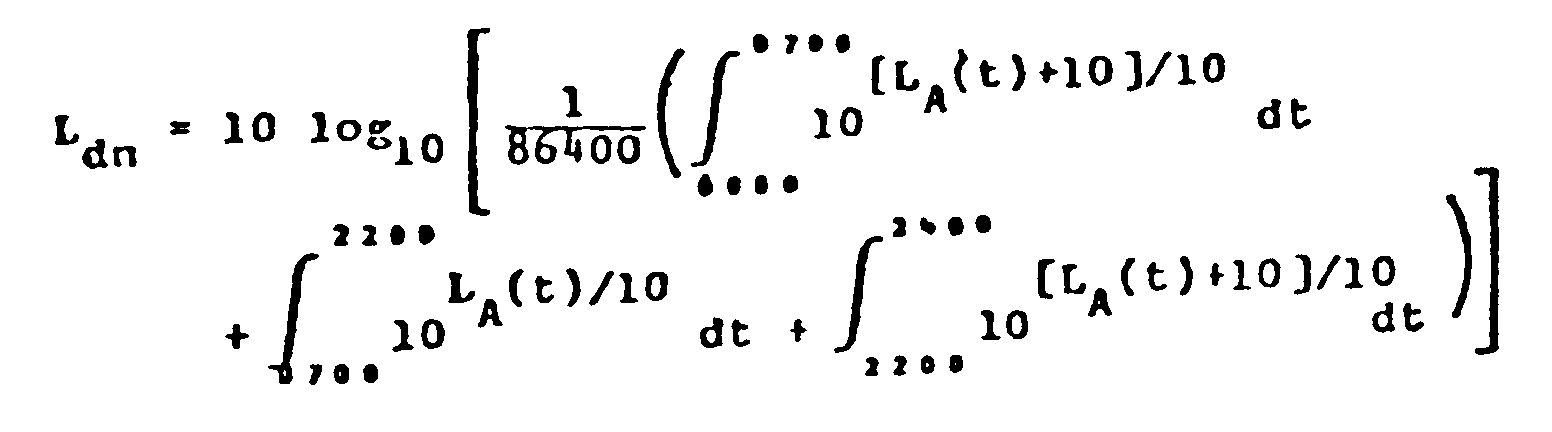
Day-night average sound level, abbreviated as DNL, and symbolized mathematically as Ldn is defined as:
Time t is in seconds, so the limits shown in hours and minutes are actually interpreted in seconds. LA(t) is the time varying value of A-weighted sound level, the quantity in decibels measured by an instrument satisfying requirements of American National Standard Specification for Type 1 Sound Level Meters S1.4–1971.
3. Loud Impulsive Sounds. When loud impulsive sounds such as sonic booms or explosions are anticipated contributors to the noise environment at a site, the contribution to day-night average sound level produced by the loud impulsive sounds shall have 8 decibels added to it in assessing the acceptability of a site.
A loud impulsive sound is defined for the purpose of this regulation as one for which:
(i) The sound is definable as a discrete event wherein the sound level increases to a maximum and then decreases in a total time interval of approximately one second or less to the ambient background level that exists without the sound; and
(ii) The maximum sound level (obtained with slow averaging time and A-weighting of a Type 1 sound level meter whose characteristics comply with ANSI S1.4–1971) exceeds the sound level prior to the onset of the event by at least 6 decibels; and
(iii) The maximum sound level obtained with fast averaging time of a sound level meter exceeds the maximum value obtained with slow averaging time by at least 4 decibels.
Cite this article: FindLaw.com - Code of Federal Regulations Title 24. Housing and Urban Development 24 CFR Pt. 51, Subpt. B, App. I Appendix I to Subpart B of Part 51—Definition of Acoustical Quantities - last updated January 02, 2025 | https://codes.findlaw.com/cfr/title-24-housing-and-urban-development/cfr-pt-24-51-subpt-b-app-i/
FindLaw Codes may not reflect the most recent version of the law in your jurisdiction. Please verify the status of the code you are researching with the state legislature before relying on it for your legal needs.
Get help with your legal needs
FindLaw’s Learn About the Law features thousands of informational articles to help you understand your options. And if you’re ready to hire an attorney, find one in your area who can help.
