
Learn About The Law
Get help with your legal needs
FindLaw’s Learn About the Law features thousands of informational articles to help you understand your options. And if you’re ready to hire an attorney, find one in your area who can help.
Current as of January 02, 2025 | Updated by Findlaw Staff
Table 1—Category 1 and Category 2 Threshold
The terabecquerel (TBq) values are the regulatory standard. The curie (Ci) values specified are obtained by converting from the TBq value. The curie values are provided for practical usefulness only.
|
Radioactive material |
Category 1 |
Category 1 |
Category 2 |
Category 2 |
|---|---|---|---|---|
|
(TBq) |
(Ci) |
(TBq) |
(Ci) |
|
|
Americium-241 |
60 |
1,620 |
0.6 |
16.2 |
|
Americium-241/Be |
60 |
1,620 |
0.6 |
16.2 |
|
Californium-252 |
20 |
540 |
0.2 |
5.40 |
|
Cobalt-60 |
30 |
810 |
0.3 |
8.10 |
|
Curium-244 |
50 |
1,350 |
0.5 |
13.5 |
|
Cesium-137 |
100 |
2,700 |
1 |
27.0 |
|
Gadolinium-153 |
1,000 |
27,000 |
10 |
270 |
|
Iridium-192 |
80 |
2,160 |
0.8 |
21.6 |
|
Plutonium-238 |
60 |
1,620 |
0.6 |
16.2 |
|
Plutonium-239/Be |
60 |
1,620 |
0.6 |
16.2 |
|
Promethium-147 |
40,000 |
1,080,000 |
400 |
10,800 |
|
Radium-226 |
40 |
1,080 |
0.4 |
10.8 |
|
Selenium-75 |
200 |
5,400 |
2 |
54.0 |
|
Strontium-90 |
1,000 |
27,000 |
10 |
270 |
|
Thulium-170 |
20,000 |
540,000 |
200 |
5,400 |
|
Ytterbium-169 |
300 |
8,100 |
3 |
81.0 |
Note: Calculations Concerning Multiple Sources or Multiple Radionuclides
The ”sum of fractions” methodology for evaluating combinations of multiple sources or multiple radionuclides is to be used in determining whether a location meets or exceeds the threshold and is thus subject to the requirements of this part.
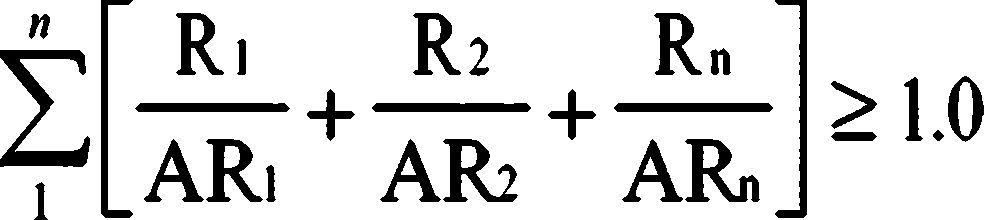
I. If multiple sources of the same radionuclide and/or multiple radionuclides are aggregated at a location, the sum of the ratios of the total activity of each of the radionuclides must be determined to verify whether the activity at the location is less than the category 1 or category 2 thresholds of Table 1, as appropriate. If the calculated sum of the ratios, using the equation below, is greater than or equal to 1.0, then the applicable requirements of this part apply.
II. First determine the total activity for each radionuclide from Table 1. This is done by adding the activity of each individual source, material in any device, and any loose or bulk material that contains the radionuclide. Then use the equation below to calculate the sum of the ratios by inserting the total activity of the applicable radionuclides from Table 1 in the numerator of the equation and the corresponding threshold activity from Table 1 in the denominator of the equation. Calculations must be performed in metric values (i.e., TBq) and the numerator and denominator values must be in the same units.
R1 = total activity for radionuclide 1
R2 = total activity for radionuclide 2
RN = total activity for radionuclide n
AR1 = activity threshold for radionuclide 1
AR2 = activity threshold for radionuclide 2
ARN = activity threshold for radionuclide n
Cite this article: FindLaw.com - Code of Federal Regulations Title 10. Energy 10 CFR Pt. 37, App. A—Category 1 and Category 2 Radioactive Materials - last updated January 02, 2025 | https://codes.findlaw.com/cfr/title-10-energy/cfr-pt-10-37-app-a/
FindLaw Codes may not reflect the most recent version of the law in your jurisdiction. Please verify the status of the code you are researching with the state legislature before relying on it for your legal needs.
Get help with your legal needs
FindLaw’s Learn About the Law features thousands of informational articles to help you understand your options. And if you’re ready to hire an attorney, find one in your area who can help.
